
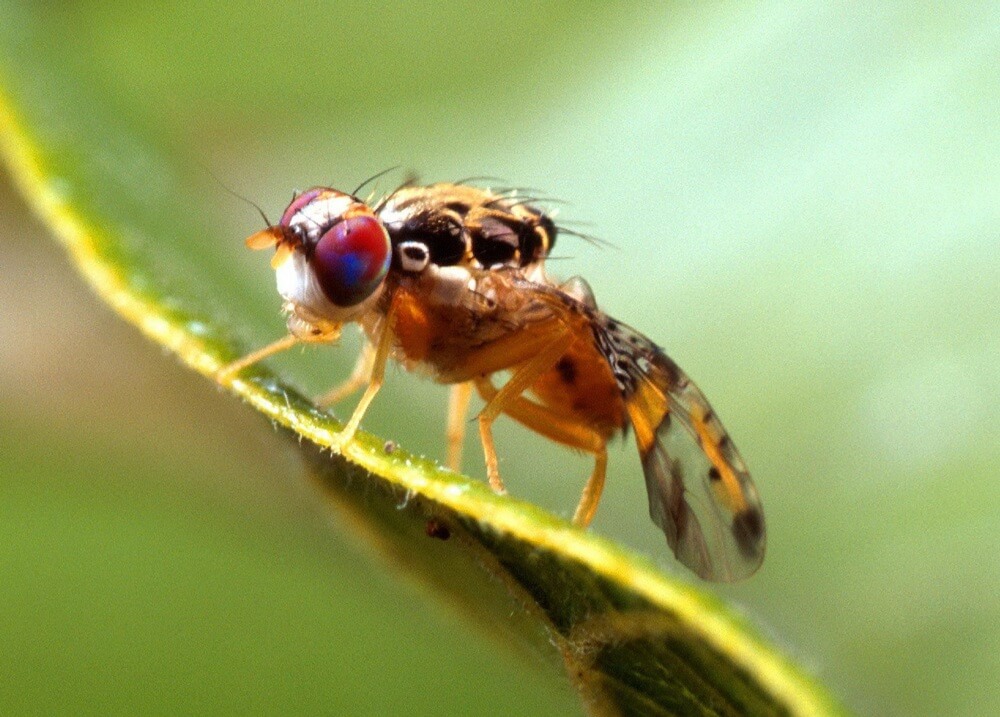
On January 5, 2026, USDA APHIS expanded the Santa Clara Mediterranean fruit fly (Ceratitis capitata) quarantine in Alameda and Santa Clara Counties, California. The NAPPO Official Pest Report #1184#1184 says the action followed the confirmed detection of one wild male Medfly from a trap on a residential orange tree in Milpitas, Santa Clara County. The report was posted on January 23, 2026.
The expansion added 17 square miles to the quarantine and did not add commercial agriculture. After the change, the amended quarantine covered 241 square miles and included 58.76 acres of commercial agriculture, with grape, olive, orange, pepper, stone fruit, and tomato listed in the official report. APHIS also reported safeguarding measures and restrictions on interstate movement of regulated articles to prevent spread from the regulated area.
The same NAPPO report gives the pest status under IPPC standards: Ceratitis capitata is a transient pest under eradication, present only in one area in California, not widely distributed, and under official control in the United States. That wording matters. It keeps the update tied to an official quarantine response rather than implying broad establishment across California.
Why Medfly response depends on detection
The EPPO Global Database overview lists Ceratitis capitata as the preferred scientific name and includes medfly and Mediterranean fruit fly as English common names. The EPPO datasheet describes the species as highly polyphagous, with larvae developing in many unrelated fruits. That host breadth is why even a single confirmed detection can trigger a formal response in a fruit-growing region.
In this case, the official trigger was narrow and specific: one wild male from one trap in Milpitas. The operational response was still broad enough to adjust quarantine boundaries, regulate movement, and coordinate APHIS, CDFA, and county agricultural commissioners. For surveillance programs, that sequence reinforces a practical point: trap detections are not just field observations. They can become the evidence base for quarantine boundaries and follow-up actions.
The lure connection
EPPO states that males of Ceratitis capitata are attracted to trimedlure and enhanced ginger oil, while both sexes can also be monitored with traps baited with protein-based attractants. For male-targeted monitoring, trimedlure is therefore directly relevant to Medfly surveillance. It helps programs detect male activity, focus delimitation work, and track whether detections continue after a response begins.
Trimedlure is also associated with male annihilation technique programs, but field deployment is not a universal recipe. Trap density, lure format, toxicant pairing, regulatory approvals, and treatment timing have to be validated within the local program. For a quarantine event like the Santa Clara expansion, the defensible statement is that male lures support detection and monitoring; they do not replace official survey, treatment, movement control, or eradication protocols.
The ECOPHERO solution
For Mediterranean fruit fly projects, ECOPHERO lists Trimedlure (tert-butyl 4-chloro-2-methylcyclohexane-1-carboxylate, CAS 12002-53-8) with Ceratitis capitata as the target pest in the product catalog. The catalog also lists Ceralure B1 as an upgraded male lure for Ceratitis capitata.
- Active: Trimedlure (tert-butyl 4-chloro-2-methylcyclohexane-1-carboxylate) (CAS 12002-53-8)
- Related catalog item: Ceralure B1 for Mediterranean fruit fly
- Mode: Male lure monitoring and lure-and-kill support where locally approved
- Application: Medfly detection, surveillance, and program support traps
The product fit here is direct because the event pest is Ceratitis capitata and the catalog target pest is also Ceratitis capitata. Ceralure B1 is included as a related Medfly lure, but no CAS number is assigned to that catalog row, so specifications should be confirmed during procurement.
What buyers should take from this event
The California quarantine expansion is a reminder that fruit fly programs need fast, species-specific monitoring inputs before and after detections. A single confirmed Medfly can lead to a defined quarantine area, movement restrictions, and sustained official control work. Semiochemical lures are one part of that response system because they help generate the detection record that program managers need.
ECOPHERO manufactures pheromone and semiochemical active ingredients for projects ranging from gram-scale development to ton-scale custom synthesis. If you are working on Mediterranean fruit fly monitoring, Medfly response planning, or trimedlure procurement, contact us with the pest name, product name, or CAS number. For this topic, include Ceratitis capitata, Trimedlure, or CAS 12002-53-8 so our team can confirm specification, lead time, and synthesis scale.
Sources
- NAPPO Official Pest Report #1184#1184: Ceratitis capitata (Mediterranean Fruit Fly): APHIS Expands a Quarantine Area in California
- EPPO Global Database: Ceratitis capitata overview
- EPPO Datasheet: Ceratitis capitata
- Image: Mediterranean fruit fly (Ceratitis capitata) adult, Scott Bauer / U.S. Department of Agriculture, public domain.

