
EPPO added Erthesina fullo, the yellow-spotted stink bug, to its Alert List in its August 2026 reporting cycle. The decision reflects the pest's invasive behaviour, broad host range and potential to damage economically important fruit crops. The EPPO Alert List profile brings together the evidence behind the addition and the surveillance questions it creates for the region.
The date assigned to this article is an editorial date. EPPO identifies the addition at month level as 2026-08 but does not provide a publication day on the profile or Reporting Service article. August 31 must therefore not be read as a detection date, a first-record date or a claimed EPPO publication day.
A regional signal, not a single new outbreak
This Alert List addition is broader than one location-specific outbreak. EPPO records E. fullo as established in Albania with present, restricted distribution. It also cites isolated specimens in Belgium, Greece and Italy, as well as an interception in Czechia. The EPPO Reporting Service article 2026/187 presents the same regional picture.
Those records should not be collapsed into a claim that the pest is established throughout Europe. An established, restricted distribution in Albania is different from an isolated specimen or interception elsewhere. Preserving these distinctions is essential when defining survey areas, interpreting a finding and communicating plant-health risk.
The EPPO Global Database overview identifies the species under EPPO code ERTNFU and gives yellow spotted stink bug as its English common name. Its world-distribution record provides country-level status context, but the Alert List profile remains the source for the 2026 addition and its rationale.
Fruit crops and transport pathways drive concern
EPPO describes E. fullo as highly polyphagous, feeding on more than 60 host species across more than 30 plant families. Economically important hosts include kiwifruit, pear, apple, peach, apricot, pomegranate, Chinese jujube, citrus and macadamia. Forest, ornamental and wild plants can also serve as hosts.
Nymphs and adults feed on leaves, flowers, shoots and fruit. EPPO reports effects including discoloration, wilting, defoliation, dry or corky tissues, fruit deformation and reduced fruit quality. At the same time, EPPO explicitly notes uncertainty about establishment limits, population growth and damage under conditions in the EPPO region. Native-range loss figures should not be treated as forecasts for European orchards.
Long-distance movement is mainly human-assisted. Eggs and nymphs may travel on host plants, while adults can hitchhike in containers, vehicles, machinery and luggage. That pathway profile complicates early detection because entry may occur away from orchards or conventional plant consignments. Ports, logistics areas, vehicle yards, warehouses, urban host plants and buildings may all be relevant to a risk-based surveillance design.
EPPO also notes that adults aggregate and can overwinter in large numbers in buildings. Aggregation behaviour is operationally relevant, but it does not by itself prove that a commercial aggregation-pheromone lure exists or performs effectively in the EPPO region.
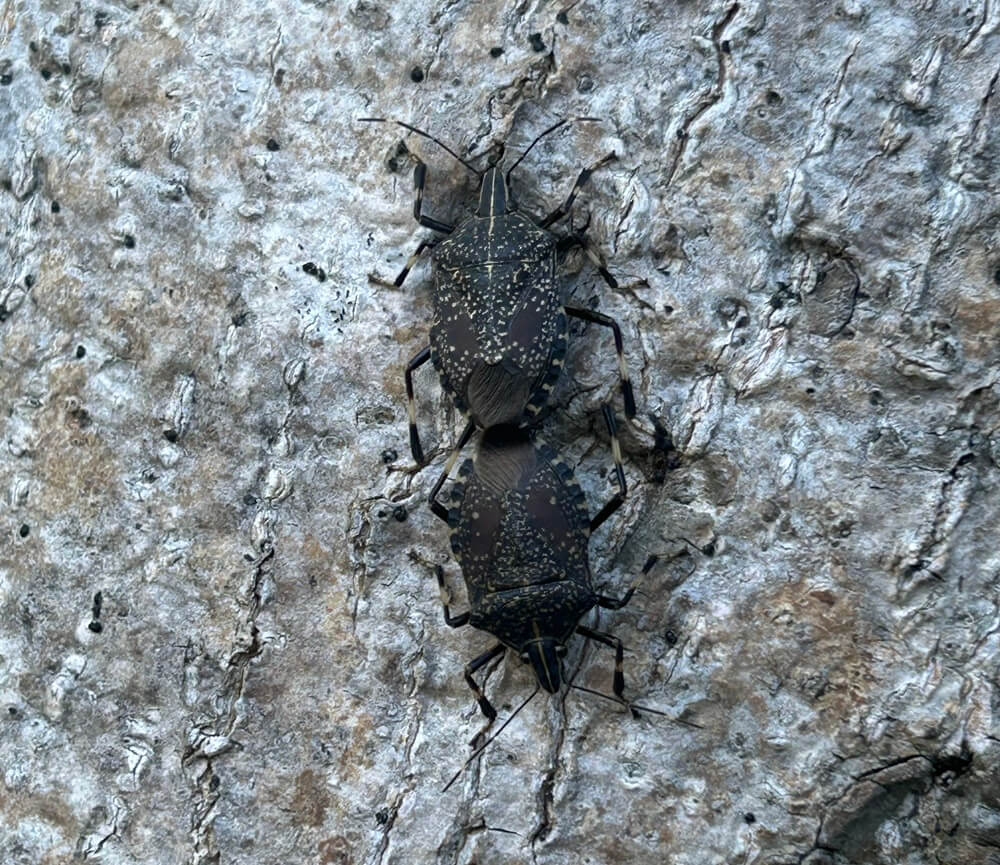
The cover photograph shows two adult E. fullo mating on a tree in Japan. It is species-context imagery, not evidence from Albania or any of the isolated European records.
Building a monitoring-development program without overstating readiness
ECOPHERO's current catalog does not list a product targeting Erthesina fullo or the genus Erthesina. This article therefore does not recommend a catalog lure, assign a CAS number to the pest, or claim a field-proven monitoring solution.
For teams assessing semiochemical options, the first step can be a semiochemical literature review. The review should separate alarm, aggregation, sex, host-related or other chemical cues; identify the life stage and behaviour studied; and distinguish laboratory evidence from field attraction. The source-backed observation that adults aggregate is a reason to investigate, not a substitute for that evidence review.
If the literature supports a candidate, ECOPHERO can handle a candidate pheromone or attractant synthesis inquiry and analytical verification. These stages establish whether material can be prepared and its identity and quality assessed. They do not establish attraction, detection sensitivity or operational value.
The next stage may include lure formulation and dispenser optimization support. Release profile, stability, loading and dispenser format would need to be evaluated against the intended monitoring period and environment. A formulation suitable for one season, climate or trap arrangement cannot be assumed to transfer unchanged to another.
Finally, monitoring-program design and field-validation coordination can connect candidate tools to the real surveillance question. A useful plan should define whether the objective is early detection, delimitation, pathway surveillance or seasonal population tracking. It should also specify locations, comparators, replication, observation timing, handling of zero catches and criteria for interpreting positive detections.
This staged route keeps two claims separate. EPPO's Alert List decision establishes a plant-health reason to watch E. fullo. A semiochemical monitoring claim requires additional, target-specific evidence generated through development and field validation.
Sources and image credit
- EPPO Alert List — Erthesina fullo
- EPPO Reporting Service 2026/187 — “Erthesina fullo, the yellow-spotted stink bug: addition to the EPPO Alert List”
- EPPO Global Database — Erthesina fullo (ERTNFU) overview
- EPPO Global Database — Erthesina fullo (ERTNFU) world distribution
- Yellow-spotted stink bug photograph and CC0 evidence — AuguMaugu (Wikimedia Commons)

_in_Japan_photo_1.jpg)