
Canada has reported an established spotted lanternfly population in Windsor and Essex County, Ontario. An official pest report posted by the North American Plant Protection Organization (NAPPO) on October 23, 2026, records the Canadian Food Inspection Agency’s confirmation following surveys in fall 2026. The report describes this as Canada’s first detection of spotted lanternfly, Lycorma delicatula.
A regulated area took effect on October 23, covering the City of Windsor, the County of Essex, the Township of Pelee and the Municipality of Chatham-Kent. That date marks the start of the regulated area. The report does not supply an exact date for the initial detection, so October 23 should be understood as a regulatory milestone in the response.
Established population and official status
The NAPPO report states that fall surveys confirmed establishment in the Windsor and Essex County area. It gives Canada’s official pest status as “present but not widely distributed and under official control”. Both details matter when interpreting the announcement: the report identifies an established population in a specified area while retaining a national status that describes limited distribution and official control.
The four jurisdictions included in the regulated area should also be read alongside the report’s more specific establishment finding. Windsor and Essex County are the locations named in the confirmation of an established population. The regulated-area announcement additionally names Pelee and Chatham-Kent. Keeping those geographic descriptions distinct helps readers avoid extending the reported establishment finding to every location covered by the regulatory boundary.
Surveillance continues beyond the boundary
CFIA’s spotted lanternfly information page says surveillance outside the regulated area is ongoing. The announcement therefore has relevance both for the area with confirmed establishment and for surveillance planning elsewhere. An established population in one reported area does not, by itself, describe the situation at an unreported location.
CFIA also identifies tree-of-heaven as one of spotted lanternfly’s preferred hosts and says it targets locations of that tree for detection. For readers considering surveillance priorities, this provides a specific example of how the agency links host information to detection activity. It supports attention to a named host within surveillance planning, without establishing that every tree-of-heaven location contains the insect or that surveillance can be limited to that host alone.
Egg masses keep outdoor-item inspections relevant
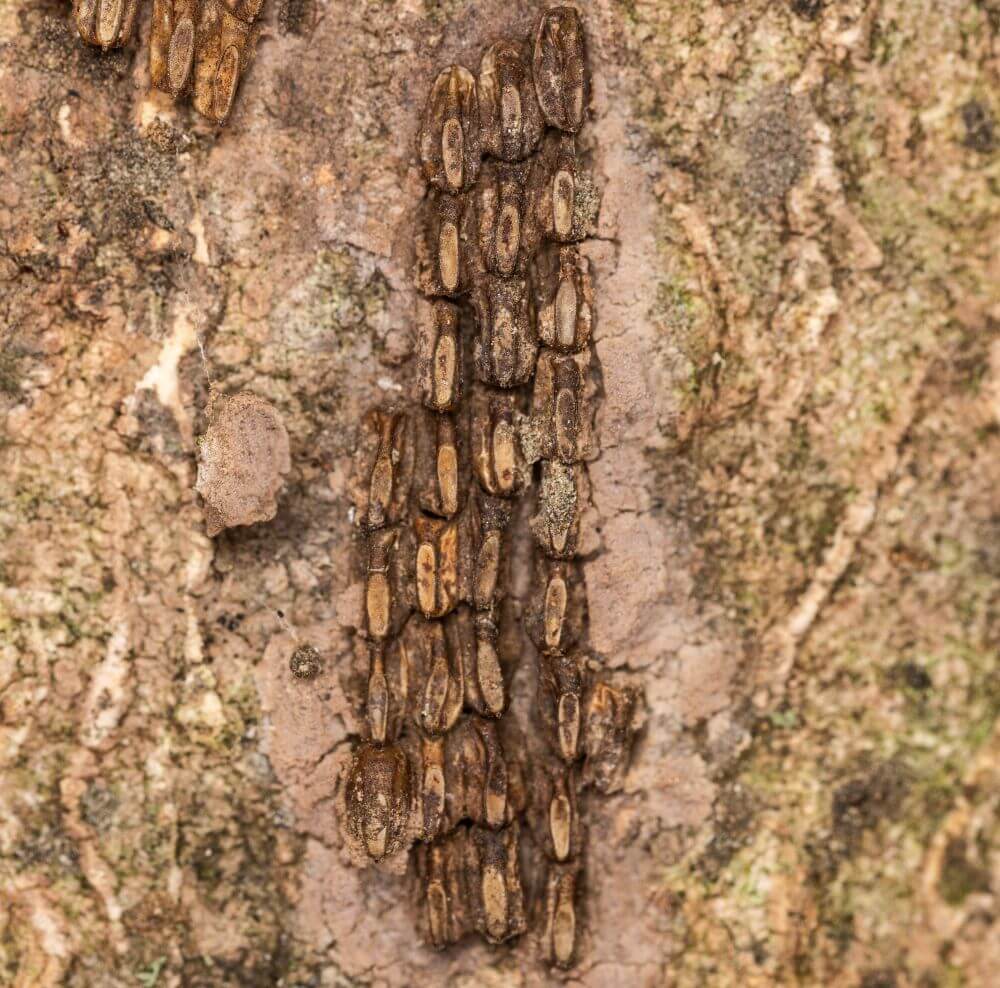
The agency’s guidance draws attention to egg masses as well as the insect itself. CFIA says these egg masses can survive winter temperatures and hatch in spring. Its advice includes inspecting items stored outside for egg masses, with vehicles and patio furniture among the examples. The connection between overwintering eggs and outdoor-item checks gives readers a concrete subject to look for when consulting the guidance.
The cover photograph illustrates spotted lanternfly egg masses in Pennsylvania. It is an identification-context image, separate from the evidence documenting the Ontario report. Readers should use CFIA’s linked information for its inspection guidance and the NAPPO report for the dated account of establishment and the regulated area. Together, those sources connect the announcement with practical awareness of the egg stage without implying that a photograph documents the Canadian detection.
ECOPHERO: surveillance planning and field validation
For organizations assessing spotted lanternfly surveillance needs, ECOPHERO welcomes service inquiries about monitoring-program design and field-validation coordination. The Ontario announcement provides a reason to discuss how a monitoring program’s objectives relate to the reported locations, continued surveillance outside the regulated area, and the agency’s attention to preferred-host locations and egg masses.
This service scope does not establish the availability or efficacy of an ECOPHERO catalog lure for spotted lanternfly. No catalog product match is established for this pest, and no registered use, CFIA endorsement or field-proven solution is claimed. Organizations can inquire about monitoring-program design and field-validation coordination while using the official sources below to understand the reported event and CFIA’s public guidance.
