
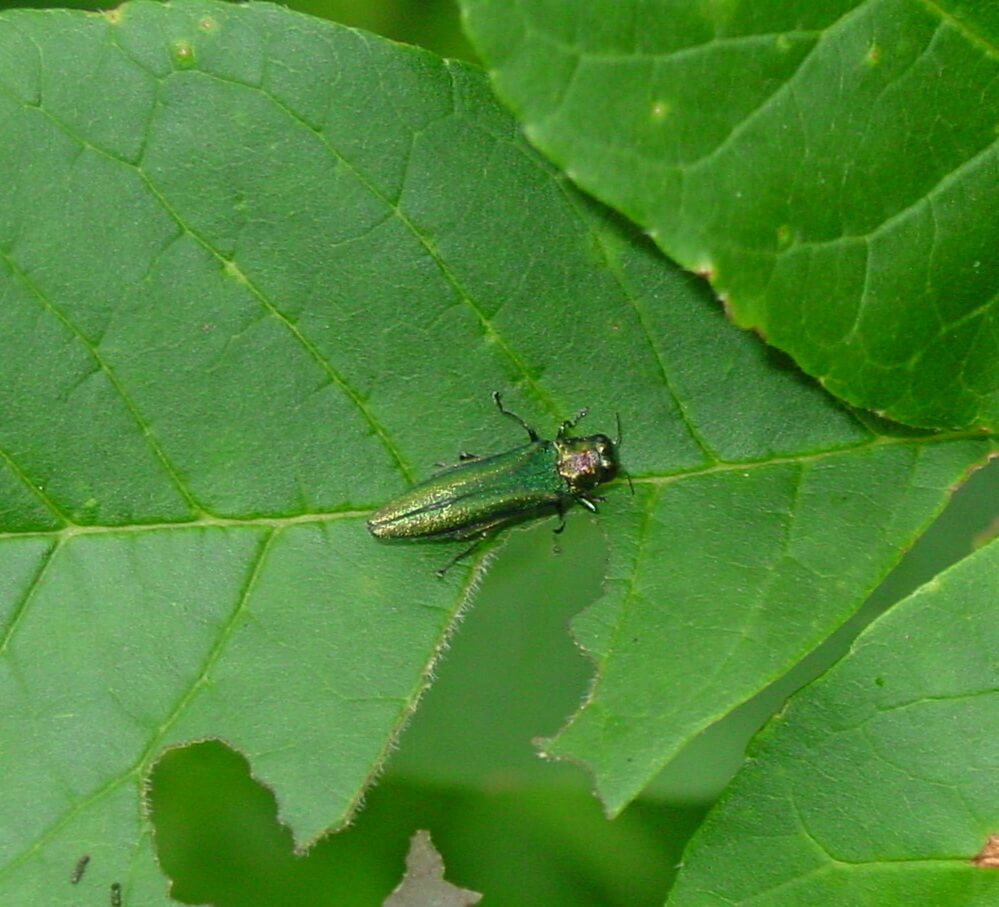
EPPO's July 2026 Reporting Service recorded the first report of emerald ash borer, Agrilus planipennis, in Slovakia. The detection was based on adult insects caught in a pheromone funnel trap in Eastern Slovakia.
According to EPPO Reporting Service article 2026/163, 18 adult specimens of A. planipennis were caught on June 25, 2026. The trap was installed on an ash tree in the park next to the manor-house of Streda nad Bordogom, in the Trebisov district of the Kosice region.
The report also placed the finding in a wider European context. EPPO stated that this was the second report of the pest in the European Union after the Hungary finding reported in June 2026.
EPPO gave the official pest status for Slovakia as “Transient.” That exact status should be preserved. The article supports a first-detection and monitoring signal, not a claim that the pest is established throughout Slovakia.
What the trap record shows
The source evidence is specific: 18 adult emerald ash borers were caught in a pheromone funnel trap on an ash tree on June 25, 2026. That gives the event a clear species, date, location, host context, and detection method.
It is also important not to over-read the trap record. A trap catch confirms the presence of adult insects at the monitored site. It does not, by itself, quantify the population, define the infested area, prove a breeding population, or establish the pest's pathway into the country. Those questions belong to official follow-up and wider surveillance.
For technical teams, the practical significance is that pheromone-based detection can surface a target pest early enough to support official decision-making. In this case, the trap record was strong enough to appear in EPPO's Reporting Service as the first report for Slovakia.
Why the European context matters
EPPO described the Slovakia finding as the second report of Agrilus planipennis in the European Union after the Hungary finding in June 2026. That sequence matters because it shows two EU reports close in time, without requiring the article to infer a spread pathway.
The source does not say that the Slovakia record came from Hungary, and it does not give a regional population estimate. A careful article should therefore avoid pathway speculation. The useful point is narrower: official detection systems are now reporting A. planipennis events inside the EU, and species-specific monitoring tools need to be matched precisely to the pest named in the report.
That is where catalog identity becomes important. When a pest record is as consequential as a first national report, the product reference should use exact scientific-name and CAS matching rather than a general borer category.
ECOPHERO catalog match
The ECOPHERO catalog directly matches (Z)-3-Dodecen-12-olide to Agrilus planipennis:
- Product: (Z)-3-Dodecen-12-olide
- CAS number: 87371-99-1
- Catalog target pest: Agrilus planipennis
- Match type: Direct catalog match
The direct match is the publication-relevant product fact. The pest named in the EPPO report is the same pest listed in the catalog row, and the CAS number is 87371-99-1.
This should be framed as a species-specific material match for monitoring and detection workflows. The source evidence does not support claims that the product eradicates emerald ash borer, prevents establishment, or replaces official phytosanitary response.
Using the signal responsibly
First reports can attract attention, but technical communication should remain disciplined. The Slovakia record is a dated EPPO report based on a specific trap catch. It should be described as a reported detection in Streda nad Bordogom on June 25, 2026, with official pest status “Transient.”
For monitoring programs, that kind of record underlines the value of maintaining tools that are matched to the target species. A product name alone is not enough; teams also need the CAS number and the catalog target pest to align with the official report.
ECOPHERO's catalog-backed match gives procurement, formulation, and field-support teams the core specification they need to discuss A. planipennis: (Z)-3-Dodecen-12-olide, CAS 87371-99-1.
Contact us with the pest name or CAS number for a quote.

.jpg)