
Moldova's National Food Safety Agency (ANSA) reported Lycorma delicatula, commonly known as spotted lanternfly, in a notice dated August 24, 2026. The EPPO Reporting Service identifies this as the first report of the pest in Moldova and the first report in the EPPO region.
The finding matters beyond a single site. Spotted lanternfly is a mobile, polyphagous pest whose early detection can shape the options available to plant-health authorities. It also presents a practical surveillance challenge: a response must distinguish the original outbreak from later observations and determine whether additional populations remain inside or outside the initial response area.
The date above is the publication date of ANSA's official notice, not a claimed detection date. Neither the EPPO article nor the ANSA notice gives a day-level date for the original field detection.
What authorities found in Chisinau
According to EPPO, an outbreak was detected in an industrial area in Chisinau municipality. Adults and nymphs were found on spontaneous vegetation, particularly tree of heaven (Ailanthus altissima). Moldova's National Reference Laboratory, IP CNSAPSA, confirmed the pest's identity.
ANSA established an infested area and a buffer zone, ordered emergency measures, and treated approximately 7,000 square metres in the affected area. The ANSA notice says monitoring showed that the outbreak within the initially delimited space had been eradicated.
That was not the end of the response. EPPO reports that subsequent monitoring in the buffer zone detected isolated spotted lanternfly populations in public spaces. Further phytosanitary action was planned for those populations. This distinction is important: eradication of the initial industrial-area outbreak does not mean that every later observation in the wider monitored area had already been resolved.
EPPO gives Moldova's officially declared pest status as Transient. That exact status should not be replaced with "present," "established," or similar wording. It reflects the official assessment reported with the response measures and subsequent isolated findings.
Why delimiting surveillance matters
The EPPO datasheet for Lycorma delicatula describes early detection as a factor that may allow action to prevent spread from an introduction point. In Moldova, the sequence of an initial outbreak, a delimited response area, and later isolated findings illustrates why surveillance design must preserve location and timing context.
A useful delimiting program starts with a clear question. Is the objective to confirm whether the pest remains near the original site, define the outer boundary of observations, assess pathways into nearby public spaces, or measure change after control measures? Each objective affects site selection, observation frequency, field records, and the criteria used to interpret a new detection.
The EPPO overview confirms the pest identity and EPPO code LYCMDE. The event sources establish the Moldova facts, but they do not validate a commercial lure, specify a pheromone blend, prescribe trap density, or report field performance for a semiochemical monitoring system in Chisinau. Those questions require separate technical evidence and local validation.
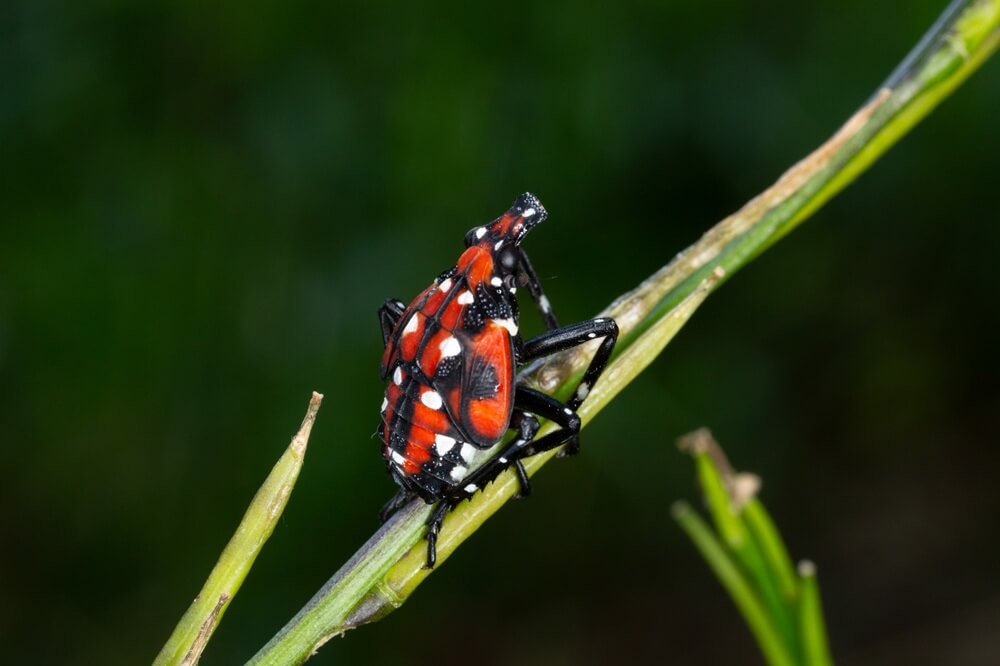
The cover image shows a fourth-instar spotted lanternfly nymph photographed in Pennsylvania. It is provided as species and life-stage context only; it is not an image from the Moldova outbreak and should not be used as evidence of the Chisinau detections.
A staged semiochemical development path
ECOPHERO does not currently list a catalog product targeting Lycorma delicatula or the genus Lycorma. This article therefore does not recommend a catalog lure, attach a CAS number to the pest, or claim a field-proven spotted lanternfly solution.
For surveillance teams evaluating whether semiochemical tools could support future spotted lanternfly work, ECOPHERO can begin with a semiochemical literature review. That review can separate demonstrated target-species evidence from candidate attractants, host-related cues, or approaches tested in other settings. It can also define the evidence gaps that must be closed before a field claim is made.
Where the evidence supports further development, ECOPHERO can handle a candidate pheromone or attractant synthesis inquiry and analytical verification. These stages address material identity and quality; they do not by themselves demonstrate biological attraction or surveillance performance. Any candidate would still need an appropriate field comparison.
Development may then progress to lure formulation and dispenser optimization support, followed by monitoring-program design and field-validation coordination. A defensible field plan should state the surveillance objective, candidate treatment, comparator, placement logic, replication, observation schedule, environmental context, and decision criteria before deployment. Results should be interpreted only for the tested geography, season, formulation, dispenser, and trap configuration.
This staged approach keeps the response evidence and the development proposition separate. ANSA and EPPO document the pest event and official status in Moldova. Semiochemical research and field validation are the next evidence-generating steps, not conclusions that can be inferred from the outbreak notice.
Sources and image credit
- EPPO Reporting Service 2026/183 — “First report of Lycorma delicatula in Moldova and in the EPPO region”
- ANSA Moldova — “Atenție! Regim de carantină fitosanitară”
- EPPO Global Database — Lycorma delicatula (LYCMDE) overview
- EPPO Global Database — Lycorma delicatula (LYCMDE) datasheet
- USDA-ARS spotted lanternfly photograph and public-domain evidence — USDA-ARS photo by Stephen Ausmus

.jpg)