
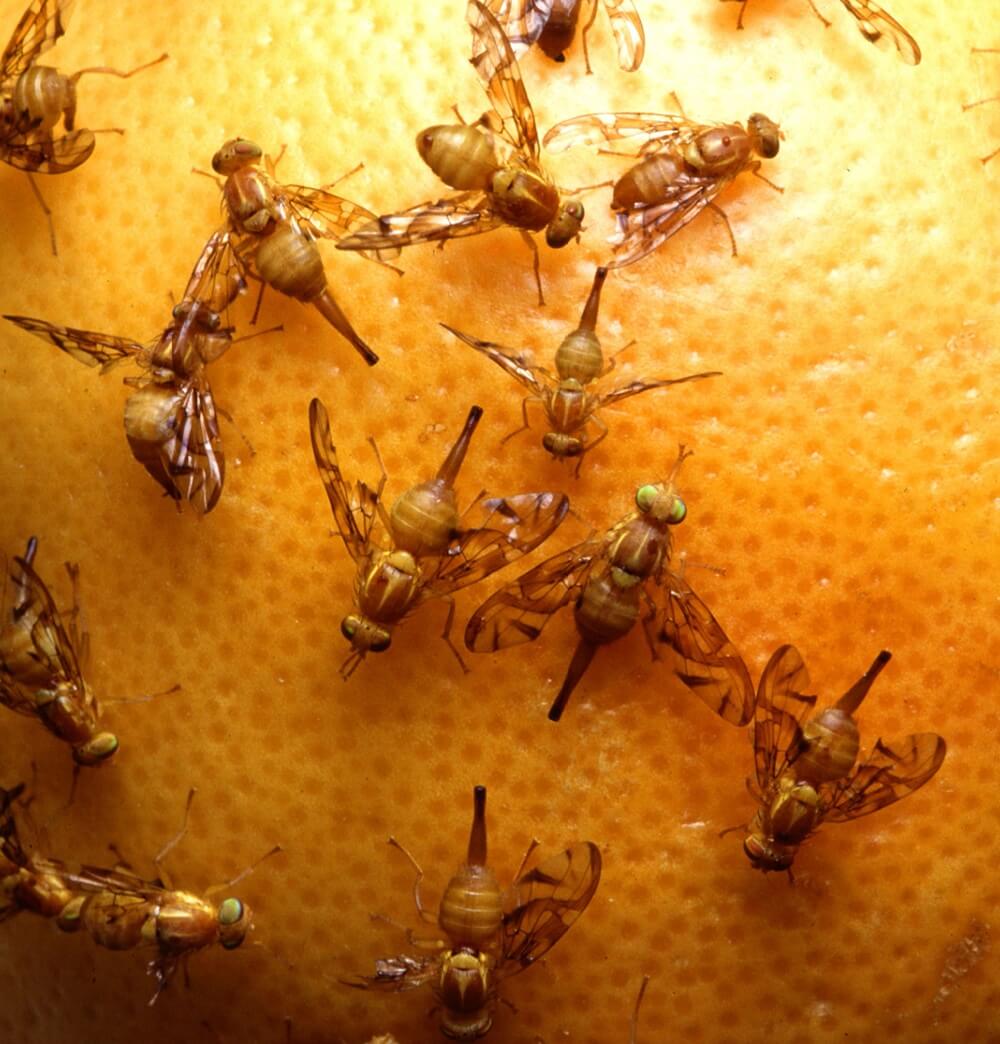
The U.S. Department of Agriculture's Animal and Plant Health Inspection Service (APHIS), working with the Texas Department of Agriculture (TDA), removed the Mexican fruit fly quarantine in Hidalgo County, Texas, on September 1, 2026. The action applied to the Peñitas-Granjeno quarantine area and was documented in USDA APHIS Program Update DA-2026-32, posted September 2, 2026.
The removal released 58.66 square miles from quarantine, including 45.03 acres of commercial citrus. Those figures describe the land released from the regulatory boundary. They should not be read as measures of fruit-fly abundance, treatment coverage, trapping density, or surveillance intensity.
APHIS identified the target as the Mexican fruit fly, Anastrepha ludens, also referred to as Mexfly. The update records a completed regulatory action in a named part of Hidalgo County rather than a claim about fruit-fly conditions across Texas or the United States.
What the APHIS update establishes
APHIS originally established the quarantine to restrict interstate movement of regulated articles from the area and prevent Mexican fruit fly from spreading elsewhere in the United States. APHIS and TDA subsequently reported that they had eradicated the transient Mexfly population using approved program control methods. The agencies then removed the Peñitas-Granjeno quarantine.
That sequence sets the boundary for interpreting the announcement: a quarantine was established, movement of regulated articles was restricted, the agencies reported eradication of the transient population, and the quarantine was removed. The update does not identify individual attractants, lures, formulations, dispensers, traps, suppliers, or monitoring schedules used in the program. It therefore does not support attributing the outcome to a particular commercial product or technology.
The timing also matters. September 1 is the event date for the removal, while September 2 is the posting date of the APHIS update. The action is best described as a dated quarantine removal, not as an ongoing removal process.
Pest identity and distribution context
Mexican fruit fly is Anastrepha ludens. The EPPO Global Database overview identifies it with EPPO code ANSTLU, places it in the family Tephritidae, and records the authority as (Loew). Exact identification is important because the common phrase “fruit fly” can refer to different pests with different distributions, hosts, and regulatory requirements.
The EPPO world distribution record, last updated March 23, 2026, recorded A. ludens as “Present, widespread” in Mexico. For the United States, it recorded “Present, few occurrences,” including Texas, and listed California as “Transient.” This is a database snapshot dated before the September quarantine action. It provides broader distribution context, while the APHIS update documents a later and geographically specific regulatory decision.
The two records should not be collapsed into a broader conclusion. The distribution database describes recorded status across larger jurisdictions as of its update date. The APHIS notice establishes removal of the Peñitas-Granjeno quarantine after the agencies reported eradication of the transient population there. Neither record, as supplied, supports extending that local outcome to every place where A. ludens has been recorded.
Building a species-specific post-quarantine surveillance question
A quarantine removal provides a clear reference point for future monitoring work, but it does not by itself specify which surveillance approach should be used next. A technical program needs to define the target species, geography, crop or host context, observation period, and decision the monitoring data must support. For this event, the essential identifiers are Anastrepha ludens, EPPO code ANSTLU, and the Peñitas-Granjeno area of Hidalgo County.
ECOPHERO's catalog does not list a product for Anastrepha ludens or the genus Anastrepha. Accordingly, this is a capability-led development context, not a catalog-product recommendation. ECOPHERO can support semiochemical literature review and a candidate pheromone or attractant synthesis inquiry. If a candidate direction is identified, the work can extend to lure formulation and dispenser optimization support and monitoring-program design and field-validation coordination.
These capabilities define a development pathway rather than a field-proven solution for Mexican fruit fly. Candidate chemistry, formulations, dispensers, and protocols would need evaluation for A. ludens, the intended environment, and the monitoring objective before conclusions could be drawn about performance. Any regulatory surveillance or quarantine decision remains with the responsible plant-health authorities.
From literature review to field validation
A focused inquiry should start with the operational question. The brief could identify whether the goal is early detection, delimitation, post-quarantine observation, or evidence for another program decision. It should also state the target geography and host context, expected deployment conditions, comparison design, observation window, and criteria for evaluating a candidate.
Semiochemical literature review can organize the evidence and identify candidate directions or knowledge gaps. A candidate pheromone or attractant synthesis inquiry can then assess whether selected candidates are practical to prepare. Lure formulation and dispenser optimization support can translate a candidate into a defined evaluation format. Monitoring-program design and field-validation coordination can connect that format to controls, replication, observation methods, and decision criteria appropriate to the intended field setting.
The September 2026 APHIS update remains the authority for the completed Peñitas-Granjeno quarantine action. For teams planning future species-specific surveillance, ECOPHERO can help structure a documented path from a Mexican fruit fly monitoring question to candidate development and field validation. The appropriate starting brief includes the scientific name, target location, crop or host setting, monitoring objective, and evidence required for the intended decision.
Sources and image credit
- USDA APHIS Program Update DA-2026-32 — “APHIS Removes Mexican Fruit Fly (Anastrepha ludens) Quarantine in Hidalgo County, Texas”
- EPPO Global Database — Anastrepha ludens overview
- EPPO Global Database — Anastrepha ludens world distribution
- USDA APHIS — Exotic Fruit Flies
- Mexican fruit fly image and public-domain license evidence — Jack Dykinga, U.S. Department of Agriculture, Agricultural Research Service

