
China's National Agricultural Technology Extension Service Center (NATSEC, 全国农技中心) posted a notice on July 22, 2026, signed July 21, calling for stronger monitoring and control of major pests and diseases affecting autumn grain crops. The notice covers corn, rice, and soybean production across the country.
The timing matters. A July 18 report from People's Daily Online cited China's Ministry of Agriculture and Rural Affairs, describing elevated weather and autumn-grain pest risks during the main flood season, including regional flooding and more numerous landfalling typhoons. These conditions may favor migratory insects. NATSEC's response emphasizes denser surveillance, timely field action, and coordinated prevention. The pests named include Asian corn borer (Ostrinia furnacalis), striped stem borer (Chilo suppressalis), armyworm (Mythimna separata), and cotton bollworm (Helicoverpa armigera).
The pests behind the notice
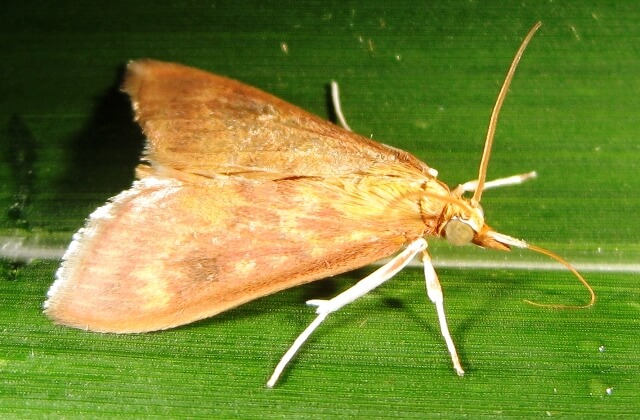
Asian corn borer is the corn-borer species listed by EPPO as Ostrinia furnacalis. NATSEC specifically tells corn-growing areas to watch 玉米螟 alongside cotton bollworm, armyworm, southern corn rust, leaf spots, and ear rot.
Striped stem borer (C. suppressalis) is listed by EPPO under several rice-borer common names, including rice stem borer and striped rice stalk borer. EPPO records China as present, widespread for this pest, matching NATSEC's rice-area warning for 二化螟.
Both are treated in the NATSEC notice as boring pests where timing matters: the notice emphasizes action during the window from egg stage to before larvae bore into the plant. That biology makes monitoring especially relevant because adult flight information helps field teams decide when to scout more closely.
What pheromone monitoring contributes
Pheromone traps detect adult flight activity. For Asian corn borer and striped stem borer, trap catches can help determine when adults are present, how activity changes across the season, and whether a population peak is building. This information supports scouting decisions — traps signal where and when to look more closely.
The NATSEC notice calls for intensified monitoring and timely action. Pheromone traps fit into this framework as an observation tool, not a stand-alone control. Catches should be interpreted alongside crop stage, field checks, local forecasts, and official thresholds. In practice, trap data should trigger field confirmation rather than replace it.
The ECOPHERO monitoring option
ECOPHERO supplies pheromone components for Asian corn borer and striped stem borer monitoring:
Asian corn borer (O. furnacalis):
- Z-12-Tetradecenyl acetate (CAS 35153-20-9)
- E-12-Tetradecenyl acetate (CAS 35153-21-0)
Striped stem borer (C. suppressalis):
- (Z)-9-Hexadecenal (CAS 56219-04-6)
- (Z)-11-Hexadecenal (CAS 53939-28-9)
Blend ratios, dispenser type, trap density, and deployment timing should follow locally validated protocols. The product components are available from gram to ton scale with standard purities of 90%, 95%, and 98%.
Working on corn or rice borer monitoring? Contact ECOPHERO with the pest name, crop, region, and intended monitoring window to discuss specifications.
Sources
- National Agricultural Technology Extension Service Center: "全国农技中心关于加强秋粮作物重大病虫害防控工作的通知," posted July 22, 2026; notice signed July 21, 2026.
- People's Daily Online — 2026 autumn-grain pest and weather-risk context
- EPPO Global Database — Ostrinia furnacalis
- EPPO Global Database — Chilo suppressalis
- EPPO Distribution — Chilo suppressalis
- Cover image: Adult Asian corn borer, Wikimedia Commons, Kembangraps, CC0.

