
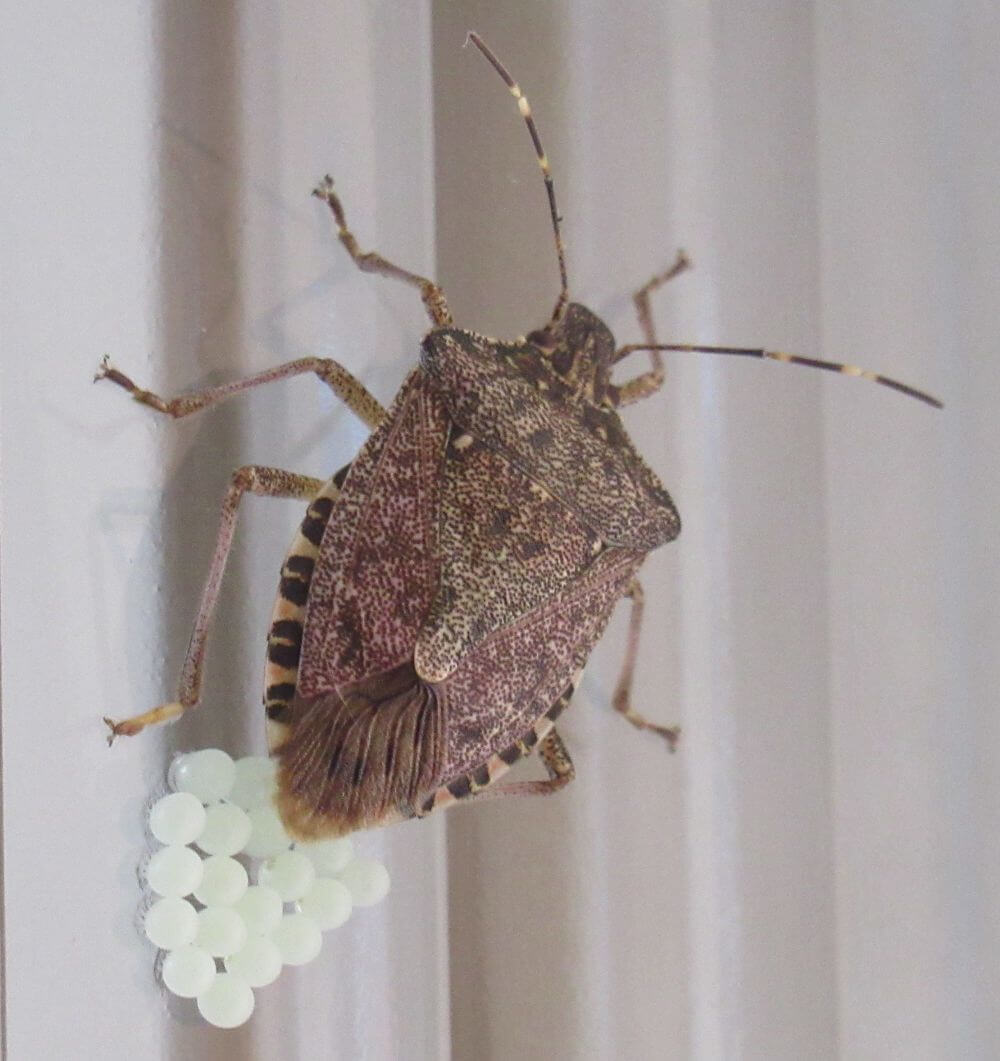
Pheromone traps can help detect brown marmorated stink bug in protected peppers, but attraction does not necessarily translate into capture. That distinction stands out in a HortiDaily report published on 21 October 2026, covering an IPM study afternoon organized by Harvestis in Belgium. The report describes greater bug activity around traps while insects regularly stayed outside them. Harvestis therefore regarded traps as insufficient for control on their own.
For pepper growers, the account puts repeated crop inspection alongside pheromone detection. It describes a monitoring task that continues after a trap is installed and after bugs or eggs have been located. The publication date identifies when this account appeared; the report does not give an exact date for the study afternoon or the stink bug work, and it is not an announcement of a new Belgian outbreak.
Why the pest matters in protected peppers
The EPPO Global Database overview identifies Halyomorpha halys as brown marmorated stink bug and describes its Far Eastern origin and invasive occurrence in North America and Europe. That background places the Belgian research discussion within the wider context of an invasive pest, without establishing the scale of any particular local infestation.
The crop concern in the Harvestis account is direct: the insect damages fruit through piercing and sucking, and several generations can develop in a greenhouse. The report consequently describes intensive searching. These observations concern the named stink bug section of a broader pepper research meeting; findings about aphids elsewhere in the report should not be treated as results for H. halys.
Pheromone detection and capture are different outcomes
The reported trap observations illustrate a practical limit of pheromone monitoring. Bugs became more active near traps, yet some remained outside. A response around a trap and the removal of insects from the crop are distinct outcomes. The account supports pheromone traps as an aid to detection and trapping, while also showing why that aid did not replace searching plants.
No quantitative capture rate or lure formulation is provided for this observation. It therefore offers no basis for selecting a blend ratio, dispenser, deployment rate or universal trap arrangement. Its useful message is narrower: assess the trap alongside what inspectors find in the crop, and retain the distinction between attracting insects and capturing them when discussing results.
The ECOPHERO catalog connection
ECOPHERO lists 4-[3-(3,3-dimethyloxiran-2-yl)-1-methylpropyl]-1-methylcyclohex-2-en-1-ol, CAS 1030630-94-4, under catalog entry EP00181. The entry also uses the abbreviation 10,11-Epoxy-1-bisabolen-3-ol and explicitly includes Halyomorpha halys among its target species. This is a species-specific catalog connection relevant to a discussion of semiochemical materials.
A catalog active ingredient and a finished monitoring product require different evidence. This listing does not establish which material Harvestis used, the composition of its traps, Belgian registration, or performance in a pepper greenhouse. It should not be read as proof that the catalog material is equivalent to the lure discussed in the report. Those distinctions matter when moving from a chemical inquiry to a proposed monitoring application.
Repeated inspection remains central to the reported approach
Harvestis described checking plants several times each week, marking plants where bugs or eggs were found, and returning to those plants daily. The emphasis was on revisiting a known finding rather than treating an initial inspection as the end of the search. In this account, pheromone detection sits beside that continuing inspection effort.
Research is also continuing through HALT-yomorpha, in which Harvestis is working with growers on biological control and forecasting models. These are research directions, not evidence of a completed forecasting tool or a validated biological control solution. Read together, the scouting observations, trap limitations and ongoing project describe work toward better monitoring and response timing, rather than a single established answer.
For an ECOPHERO inquiry, contact us with Halyomorpha halys, CAS 1030630-94-4, or the monitoring challenge you need to discuss.
