
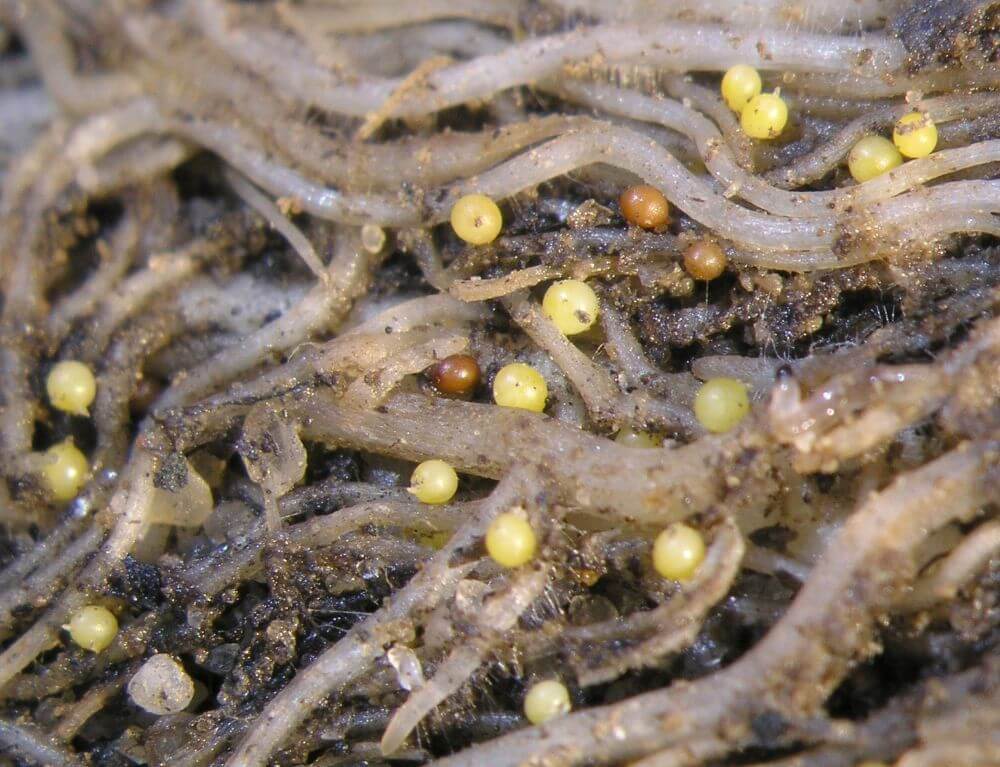
A first detection of golden nematode in New Brunswick has put a nine-hectare field under official control and prompted an investigation into the extent of its presence. In an official report published by NAPPO on October 20, 2026, the Canadian Food Inspection Agency (CFIA) confirmed Globodera rostochiensis on a farm in the province’s northwest. The report identifies one affected field; the investigation to delimit the pest’s presence was ongoing at the time of reporting.
October 20 is the publication date of the NAPPO report. An exact detection day was not provided. That distinction matters when reading the announcement: it dates the public report without assigning an unsupported start date to the detection or investigation.
What the official response covers
The NAPPO report gives Canada’s official pest status as present: not widely distributed and under official control. This is the status for Canada, while the new provincial report concerns a single field in northwestern New Brunswick. The first provincial detection and the national status describe different geographic scales and should be read together.
A same-event update from the United States Department of Agriculture’s Animal and Plant Health Inspection Service (APHIS) adds detail on the response. According to that update, CFIA suspended movement of regulated host material from the affected farm and began a ten-year trace-back and trace-forward investigation. These actions extend the inquiry beyond the initial confirmation by examining movement records associated with the affected farm.
APHIS also reports CFIA’s confirmation that no potatoes grown on the affected field in 2026 were shipped to the United States. That statement is specific to potatoes from that field and that growing year. It should retain those limits when used to describe the cross-border implications of the detection.
Why systematic soil sampling matters
The EPPO golden nematode datasheet identifies systematic soil sampling as necessary for reliable detection. For surveillance planning, this makes the sampling approach central to the question being investigated: determining where the pest is present requires evidence gathered in a systematic way. The initial nine-hectare confirmation is the reported finding, while delimitation remains a separate investigative task.
The EPPO guidance provides background for understanding the response rather than a sampling prescription for this farm. The event report does not supply a field-specific sampling layout, sample count, or completed delimitation result. Readers should therefore distinguish the general need for systematic sampling from any conclusion about how far this particular detection extends.
Shipment records guide follow-up
APHIS says it is working with CFIA and State plant health officials to review shipment records, assess risk, and decide whether soil sampling or other follow-up measures are needed. It explicitly cautions that a shipment record does not establish that golden nematode is present at a listed location.
That distinction is useful for anyone interpreting the investigation. A record can identify a connection for assessment; confirmation of pest presence is a different finding. The announced trace-back and trace-forward work should not be described as a list of additional infested sites. Likewise, the absence of 2026 shipments from the affected field to the United States should not be expanded into a conclusion about every movement covered by the wider investigation.
ECOPHERO support for surveillance planning
ECOPHERO can support monitoring-program design and field-validation coordination for golden nematode soil-surveillance planning. Its role here is planning and coordination. ECOPHERO has no approved catalog product for Globodera rostochiensis or the genus Globodera, and this support is not an existing pheromone lure or a nematode-control treatment.
The practical focus is the monitoring challenge raised by the official reports: a confirmed field, an ongoing delimitation investigation, and records being assessed for possible follow-up. Any discussion of support should stay anchored to those distinct tasks and the need for systematic soil sampling. Planning support does not establish pest presence, replace official decisions, or demonstrate control efficacy.
Contact ECOPHERO with the pest name and your soil-surveillance planning challenge to discuss monitoring-program design and field-validation coordination.
