
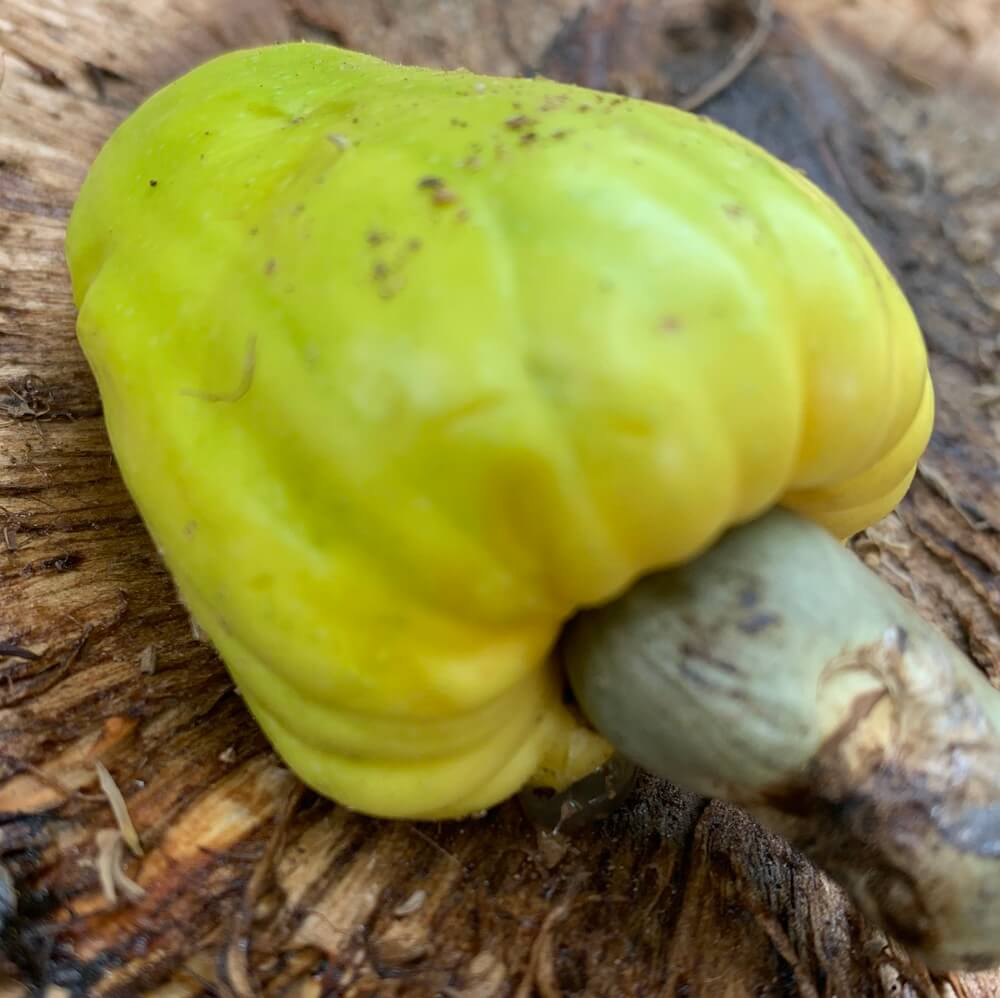
Cashew nut moth, Anacampsis phytomiella, was among the pest problems discussed in Embrapa’s October 19, 2026 report on Monitora Caju. The report followed an October 14 Café com Negócios roundtable at Embrapa Agroindústria Tropical, where the application’s monitoring methods and use in cashew production were presented. For growers and rural extension technicians, the discussion described a workflow connecting orchard observations with diagnosis and incidence calculations.
Monitora Caju had already launched in April 2026, according to Embrapa. The October discussion concerned the technology’s functions and dissemination. It did not announce a new pest outbreak or provide a new count of affected orchards. Its relevance to cashew pest monitoring lies in the reported methods for observing and recording specific plant-health problems.
From orchard observations to a diagnosis
Embrapa identifies three problems supported by the application: cashew nut moth, shoot borer Anthistarcha binocularis, and powdery mildew caused by Pseudoidium anacardii. The report says the tool helps producers and extension technicians monitor and diagnose these problems. Each has its own monitoring and diagnostic methodology within the application, according to the developer.
The reported workflow begins with what the user observes in the field. Users assess plant-health conditions and compare their observations with images in the application’s database. Information entered during that process is then used to calculate an orchard incidence index and recommend control measures. These are features described by Embrapa; the report does not supply an independent evaluation of diagnostic accuracy or insect-control performance.
That distinction matters when interpreting the incidence calculation. The tool calculates an index from observations supplied by its users. Embrapa’s description of that function is not itself a measurement of current cashew nut moth incidence across Brazil. Similarly, the presence of several problems in the application does not mean that their observation methods or resulting recommendations are interchangeable.
Why the historical moth research matters
A May 2019 Embrapa research bulletin provides background on A. phytomiella as a pest of cashew. In that historical study, researchers quantified infestation after harvest using the percentage of bored nuts. This gives readers a concrete example of how cashew nut moth infestation has been assessed in research, while keeping the measurement tied to its original study context.
The historical measurement and the application’s reported incidence calculation should be read separately. The 2019 bulletin supplies research background; the October 2026 report describes a monitoring tool. Neither source establishes that the older study’s infestation measurements represent present orchard conditions. The bulletin also cannot establish current pesticide registration or serve as a current treatment recommendation.
Access, extension and occurrence records
According to the developer’s account in the October report, Monitora Caju can be used on computers and mobile phones without an internet connection. This remains a source-reported feature. The dissemination strategy described by Embrapa involves rural extension technicians and innovation hubs, linking the application’s rollout with people who support cashew growers.
Embrapa also reports that use of the application can generate georeferenced occurrence histories and maps for the monitored pests and disease on rural properties. Such records are a described output of the tool. The October article does not present a new distribution map, establish pest spread, or quantify adoption. Readers should therefore distinguish the ability to build occurrence records from any claim about what a completed dataset already demonstrates.
ECOPHERO support for monitoring research
For cashew pest monitoring research, ECOPHERO can support semiochemical literature review and monitoring-program design and field-validation coordination. These services offer a scope for investigating monitoring questions around A. phytomiella and A. binocularis. Any discussion should begin with the pest identity and the monitoring question that needs validation.
ECOPHERO’s catalog has no listing for either species or either genus. The available support is therefore research-focused, with no existing catalog lure recommended for these pests. It carries no claim of field-proven efficacy, registered use, partnership with Embrapa, or integration with Monitora Caju. Contact ECOPHERO with the pest name and monitoring challenge to discuss semiochemical literature review or monitoring-program design and field-validation coordination.
