
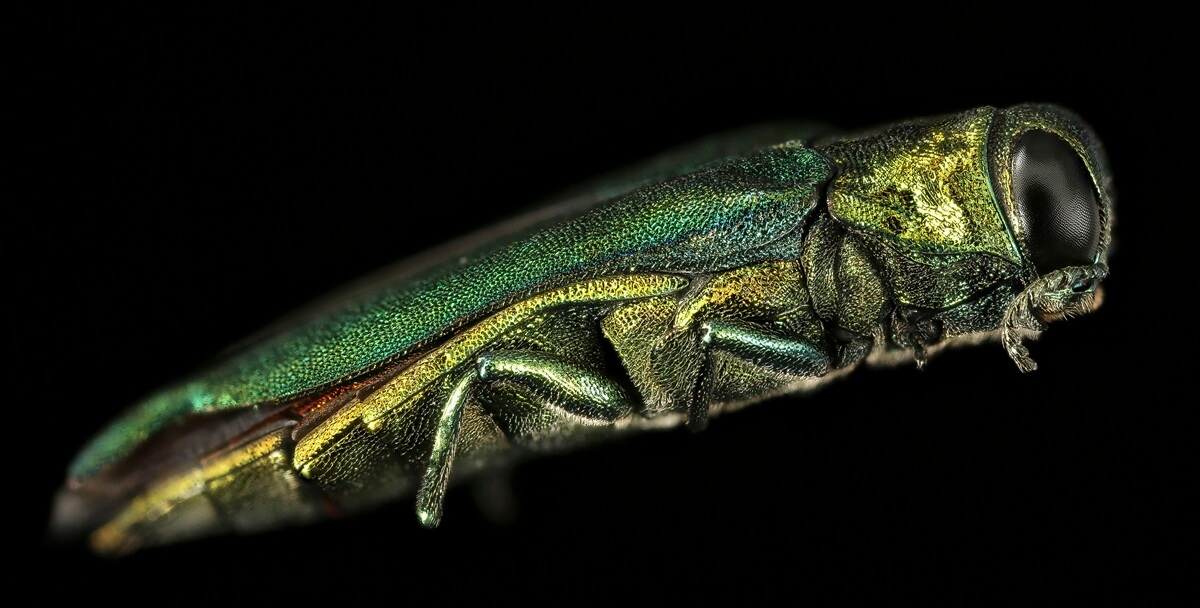
In June 2026, the NPPO of Hungary reported the first detection of emerald ash borer (Agrilus planipennis) in Hungary — and the first confirmed record of this pest anywhere in the European Union. According to EPPO Reporting Service 2026/137, one specimen was caught in a pheromone trap operated by the Sopron University – Forest Research Institute (ERTI) in Beregsurány, in the Észak-Alföld region of eastern Hungary, on 2026-06-09. The identification was confirmed through a molecular, PCR-based test by the National Reference Laboratory. Following the detection, Hungarian authorities established a demarcated area with intensified surveillance around the finding site.
The EPPO Global Database records Hungary's pest status for emerald ash borer as Transient, actionable, under surveillance, with the distribution record last updated on 2026-06-30.
Why it matters
Emerald ash borer is one of the most destructive forest pests in the world. Its larvae tunnel beneath the bark of ash trees (Fraxinus species), creating serpentine galleries that disrupt the vascular system and ultimately kill the tree, typically within a few years of infestation. The EPPO datasheet identifies Fraxinus excelsior (European ash) and other Fraxinus species as major hosts — meaning that the European ash populations that define many of the continent's lowland and riparian forests are directly at risk.
In North America, where emerald ash borer was first detected in 2002, the pest has caused widespread ash tree mortality from the expanding invasion, affecting municipal forests, nursery stock, and timber resources. The first EU detection raises the same concern for Europe: if the pest establishes and spreads, ash-dominated woodlands, urban plantings, and the nursery trade across the continent could face severe impacts. The Beregsurány finding, located in eastern Hungary near the Ukrainian border, underscores the risk of cross-border spread and the importance of surveillance at the leading edge of invasion.
How the pheromone works
Emerald ash borer females produce a contact sex pheromone that attracts males for mating. Pheromone-based monitoring uses synthetic versions of these chemical signals to draw adult beetles into traps, enabling surveillance teams to detect whether the pest is present in a given area. Because emerald ash borer is cryptic — larvae feed under bark and adults are small and elusive — visual surveys alone often miss early infestations. Pheromone traps provide a sensitive, targeted detection tool that can identify the pest before canopy symptoms become visible. This is precisely how the first Hungarian specimen was found: in a pheromone trap operated as part of a structured surveillance programme.
The ECOPHERO solution
ECOPHERO supplies the pheromone active ingredient used for emerald ash borer monitoring:
- Active: (Z)-3-Dodecen-12-olide
- CAS: 87371-99-1
- Mode: Monitoring
- Application: Monitoring traps
- Standard purities: 90% / 95% / 98%
- Custom ratios and formulations available
The active supports trap-based detection and surveillance programmes where emerald ash borer is a target pest. For plant-health authorities, forestry teams, and researchers setting up monitoring grids around the demarcated area or along potential spread corridors, (Z)-3-Dodecen-12-olide provides the chemical basis for lures used in these traps.
How pheromone monitoring supports response
For emerald ash borer, the immediate value of pheromone chemistry is surveillance. The first Hungarian specimen was detected in a pheromone trap, and EPPO reports that follow-up action included supplementary traps and targeted host-plant surveys. EPPO's datasheet also describes baited traps as survey tools for A. planipennis. In practical terms, pheromone monitoring gives plant-health teams a targeted way to check presence, delimit suspect areas, and prioritise field inspections before visible canopy symptoms become widespread.
ECOPHERO capability + CTA
ECOPHERO manufactures pheromone active ingredients from gram to ton scale. If the active ingredient you need is not in the catalogue, we make it. Contact us with the pest name or CAS number for a quote, lead time, and specification.
Sources
- EPPO Reporting Service 2026/137 - "First report of Agrilus planipennis in Hungary": https://gd.eppo.int/reporting/article-8433
- EPPO Global Database — Agrilus planipennis distribution: https://gd.eppo.int/taxon/AGRLPL
- EPPO Datasheet — Agrilus planipennis: https://gd.eppo.int/taxon/AGRLPL/datasheet
- Hero image: Emerald ash borer (Agrilus planipennis), side view. Credit: Sam Droege / USGS Bee Inventory and Monitoring Lab. License: Public domain. License URL: https://commons.wikimedia.org/wiki/File:Emerald_ash_borer,_side,_md_2016-03-03-17.18.jpg
