
Lettuce growers in England faced a warning of substantial aphid pressure in a HortiDaily report published on September 24, 2026. Citing the British Leafy Salads Association (BLSA), the report said aphids could affect 30 percent of lettuces before the season ended in mid-autumn. That figure described a projected risk. It did not establish the final proportion of the crop lost, and it should be read alongside the report’s account of high currant-lettuce aphid populations.
For monitoring, the pest’s location within lettuce is especially relevant. University of California Statewide Integrated Pest Management Program (UC IPM) guidance describes an aphid that feeds on younger inner leaves and can be concealed deep within a head. Its biology helps explain why careful inspection matters when interpreting reports of increasing pressure. The England report and the California guidance address different questions: one records an industry warning, while the other describes the pest and the difficulties involved in detecting it.
What the September report described
HortiDaily named the Midlands, North West, South East England and East Anglia among the affected growing regions. It reported that crisphead, romaine and iceberg lettuces were expected to be the worst affected. These were expectations reported during the season; the account did not provide a completed assessment of losses for each region or lettuce type.
A BLSA spokesman quoted in the report described high currant-lettuce aphid levels affecting commercially significant volumes of lettuce. The spokesman also described population peaks in late June and again during August and September. That seasonal account gives context to the late-September warning, but it does not establish a count for an individual field. September 24 is the publication date of the report, rather than a single outbreak detection date.
The attribution matters when using the warning. The figures and regional account come from HortiDaily’s reporting of industry comments. They offer a dated view of growers’ concerns as the season approached mid-autumn, with the 30 percent figure remaining a prospective estimate.
Why lettuce aphids can be missed
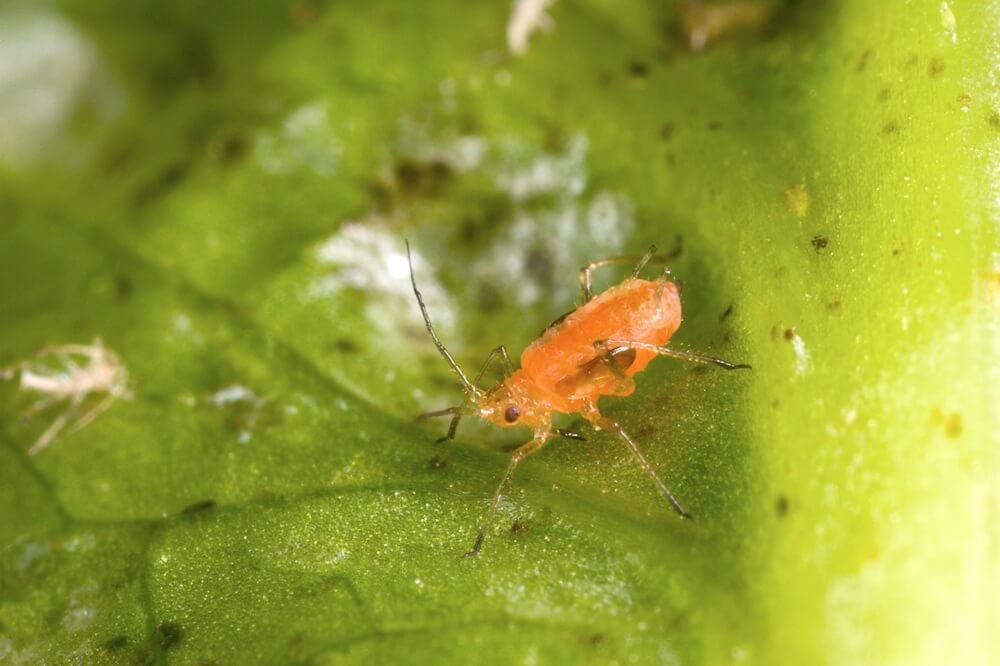
UC IPM identifies lettuce aphid as Nasonovia ribis-nigri, also written Nasonovia ribisnigri. Its description includes several colour forms, ranging from green to orange and pink. Adult winged and wingless aphids have dark markings at the joints of their legs and antennae. This variation is relevant to recognising the pest: the source describes more than one colour, alongside the markings on adults.
The same guidance describes a short life cycle and the potential for populations to increase rapidly. Feeding is directed toward the younger leaves near the centre of the plant. In head lettuce, UC IPM places the aphid almost exclusively at the heart. It also describes a tendency to disperse within the plant, unlike the colony-forming pattern it attributes to green peach aphid.
Together, those characteristics create a detection challenge. Early infestations may be hidden inside the lettuce, and UC IPM specifically calls for care in monitoring so they are not missed. The guidance connects control difficulty to both rapid population growth and the aphid’s concealed position deep in the head. Looking for the pest therefore involves attention to where it feeds as well as what the adults look like.
UC IPM’s guidance comes from California. Here, it provides background on identification, feeding location and monitoring biology. Decisions for English production require local context; the California source does not establish a UK treatment programme or confirm the extent of the reported English outbreak.
ECOPHERO support for species-specific monitoring research
ECOPHERO can support semiochemical literature review and monitoring-program design and field-validation coordination for research focused on lettuce aphid. This is prospective support for evaluating monitoring approaches. It does not establish a field-proven lure or a performance result for Nasonovia ribisnigri.
The species distinction is central to that work. Generic aphid listings do not confirm a product match for lettuce aphid, and no species-specific catalog product is offered in this article. A research discussion can begin with the named pest and the monitoring question: how to evaluate an approach for an aphid whose populations can grow rapidly while remaining concealed within lettuce. Any proposed monitoring approach would still need species-specific evidence and field validation. Careful crop inspection remains relevant to the detection problem described by UC IPM.
Sources
- HortiDaily: UK growers fearful of “worst outbreak of aphids in a generation” — September 24, 2026; reporting BLSA comments and projected seasonal risk.
- UC IPM: Lettuce Aphid — California extension background on pest identification and monitoring biology.
- Image credit and public-domain evidence: Lettuce aphid, Wikimedia Commons — Stephen Ausmus, USDA Agricultural Research Service; archival illustrative photograph.

