
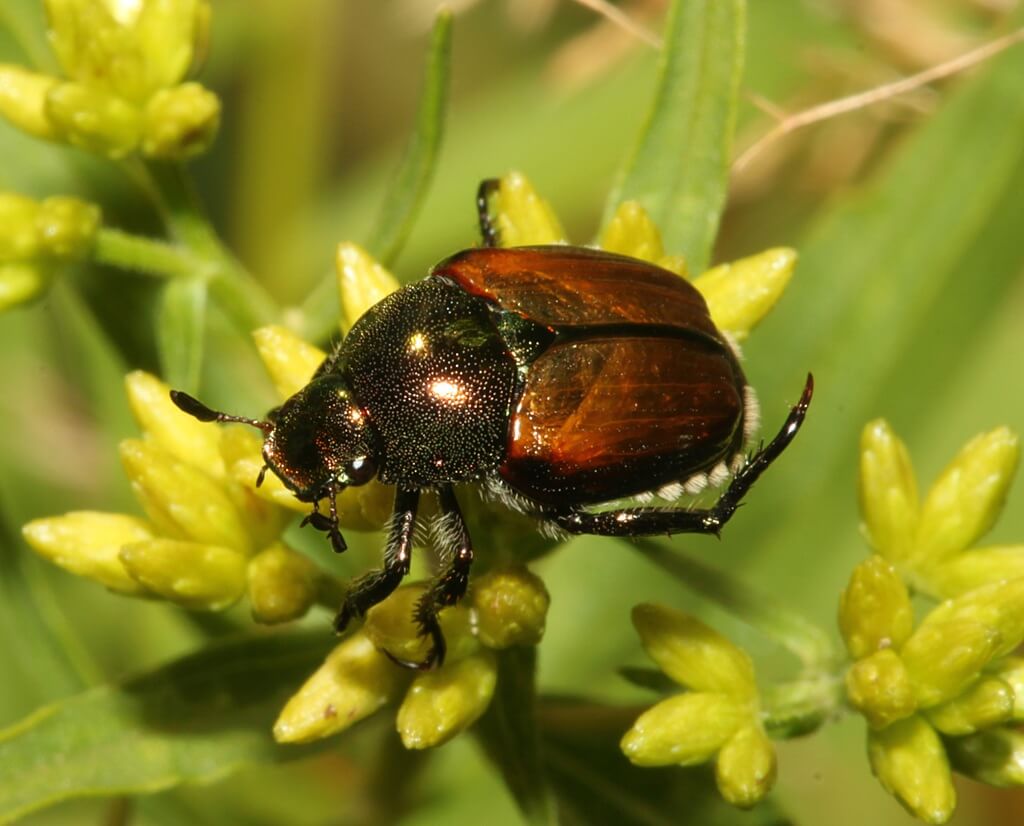
An official July 2026 report recorded multiple Japanese beetle (Popillia japonica) incursions across three regions of France. The findings extended from the eastern border area to Strasbourg and the south-east, including what the report described as the first detection in southern France.
The EPPO Reporting Service article 2026/170, based on information from the NPPO of France, covers detections made from June 16 through July 7, 2026. The report classifies every case as an incursion and says reinforced surveillance and awareness-raising were implemented.
The pattern makes early detection especially relevant. The adults were found through traps at separated sites, and several sites were close to major transport infrastructure. That geography does not, by itself, establish how the beetles arrived or moved. It does show why a monitoring network must be able to detect isolated adults and support targeted official follow-up.
What the French surveillance reported
The first 2026 finding in France was recorded on June 16. A trap at a service area on the A36 motorway in the Doubs department caught a single adult male. EPPO described it as the first record for Bourgogne-Franche-Comté as well as the first French detection of the year.
A second Bourgogne-Franche-Comté finding followed on July 7, when a trap at a motorway service area in the Côte-d'Or department caught an adult.
In Grand Est, a single adult was caught in the urban area of Strasbourg, Bas-Rhin, on June 26. Another adult was caught on July 1 in a trap close to that initial detection site.
The Provence-Alpes-Côte d'Azur findings carried additional geographic significance. On June 18, a trap in an orchard near a major transport route in Alpes-Maritimes caught one male and one female. EPPO identified this as the first detection in that region and, more broadly, the first in southern France. The report also said an insecticide treatment was planned for the orchard as a precautionary measure.
In early July, a further five adults were caught in a trap near a golf course in Alpes-Maritimes.
These records should be read as a dated surveillance snapshot, not as evidence that every location had an established population. EPPO explicitly treated the cases as incursions. The official response described in the report included reinforced surveillance and awareness activities at national and local levels.
EPPO gave the official pest status in France as “Transient, actionable, under eradication.” That wording is important: the separated catches prompted action, but the report did not classify the pest as established in France.
Why detection-focused monitoring matters
Popillia japonica is listed by EPPO as an A2 pest and categorized by the European Union as a quarantine pest. For plant-protection programs, those classifications place a premium on reliable detection and documented follow-up when adults appear in new areas.
The French records also illustrate the value of monitoring across different settings. Finds occurred at motorway service areas, in an urban area, in an orchard, and near a golf course. A dispersed set of traps can reveal geographically separated events that might otherwise remain unconnected.
Trap records must still be interpreted carefully. A catch confirms that an adult reached the trap; it does not, on its own, quantify the local population, prove a breeding population, or identify a pathway. Those questions require the wider surveillance and phytosanitary work carried out by the responsible authorities.
The July 2026 report therefore supports a practical distinction: pheromone monitoring can provide an early signal, while official investigation determines the status and appropriate response.
Japonilure for Japanese beetle monitoring
ECOPHERO's catalog directly matches Japonilure to Popillia japonica:
- Chemical name: (R,Z)-5-(1-Decenyl)dihydrofuran-2(3H)-one
- Abbreviation: Japonilure
- CAS number: 64726-91-6
- Mode: Monitoring
- Application: Sex pheromone lure for detection and monitoring traps
- Target pest: Popillia japonica
The direct pest-to-product match is important because a lure should be selected for the target species rather than inferred from a general insect group. The catalog row identifies Japanese beetle by both its common and scientific names and gives the same CAS number, 64726-91-6.
In this context, Japonilure's role is surveillance. It can be used in traps intended to detect and monitor adult Japanese beetles. It should not be described as an eradication treatment or as evidence that a site is free of the pest when a trap is empty.
Deployment decisions—including trap density, placement, inspection frequency, and the response to a catch—belong within the locally approved surveillance design. The French report documents the official findings and response; it does not provide a universal deployment protocol for other locations.
From isolated catches to an actionable signal
France's June–July 2026 detections show how individual trap catches can build a wider picture. A single male in Doubs was followed by records in Strasbourg, Côte-d'Or, and two locations in Alpes-Maritimes. The southern records were especially notable because they represented the first reported detection in that part of France.
For NPPOs, growers, landscapers, and plant-protection teams, the central lesson is not that every catch represents the same level of risk. It is that species-specific monitoring provides evidence that can trigger closer inspection and official action.
Japonilure offers a catalog-backed pheromone option for that detection and monitoring role. Its ECOPHERO catalog identity is unambiguous: Popillia japonica, Japanese beetle, CAS 64726-91-6.
Contact us with the pest name or CAS number for a quote.
Sources and image credit
- EPPO Reporting Service — “Incursion of Popillia japonica in France,” article 2026/170, July 2026 issue
- EPPO Global Database — Popillia japonica overview
- EPPO Global Database — Popillia japonica distribution
- EPPO Global Database — Popillia japonica datasheet
- Japanese beetle image and CC0 license information — Alan Schmierer via Wikimedia Commons / Flickr

_(8-11-09)_pepperell,_ma_-01_(3824391310).jpg)