
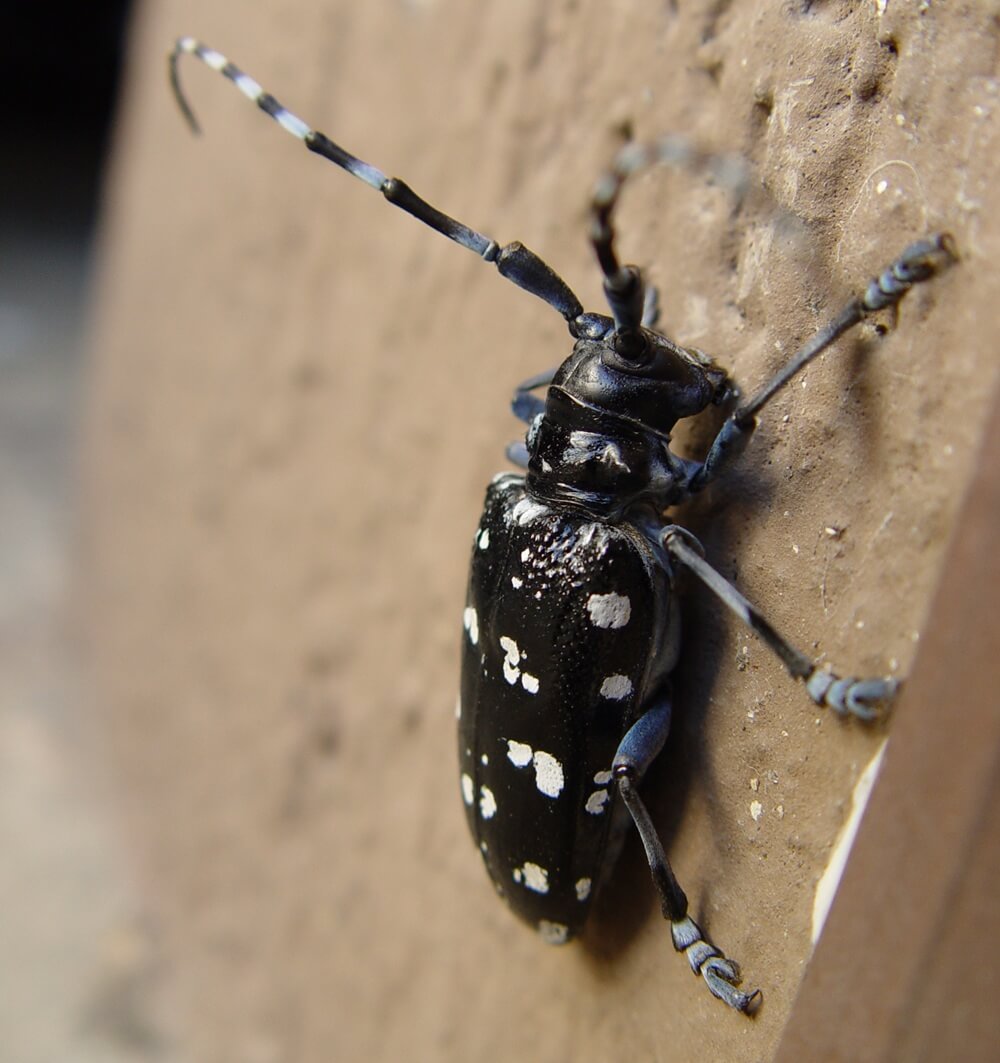
EPPO's July 2026 Reporting Service included an update on citrus longhorn beetle, Anoplophora chinensis, in Croatia. The report focused on official survey work in the demarcated area of Biograd na Moru in Zadar County, where new adult beetles were detected at the end of June 2026.
According to EPPO Reporting Service article 2026/169, five adult A. chinensis were caught in two traps in a mixed forest in the Biograd na Moru area. The same source reported bitemark damage on trees and said eradication measures would continue.
The official pest status given in the report was “Present, under eradication.” That exact wording matters. It means the Croatian situation should not be described as newly established without qualification, and it should not be treated as resolved. The report describes a continuing official eradication context with new trap evidence inside a known demarcated area.
What the Croatian report adds
The July update is not a first national record. EPPO's article states that Anoplophora chinensis was first found in Croatia in 2007 in Turanj. It also notes that several outbreaks have been found since then in Zadar County and Zagreb County.
The new point in the 2026 update is the survey result from Biograd na Moru. Five adult beetles caught in two traps represent a concrete detection signal inside the official monitoring area. Damage from bitemarks adds field evidence around the same demarcated setting.
Those facts support a careful reading. The report does not provide a population estimate, does not define a universal treatment threshold, and does not turn trap catch numbers into a general regional forecast. It does show that official monitoring remained active and that trap catches were still being recorded in the Croatian eradication program.
For teams working with quarantine pests, this distinction is important. A trap catch is not the full risk assessment by itself, but it can be a trigger for inspection, delimitation, and official follow-up under the authority's program.
Why a species-specific product match matters
Citrus longhorn beetle belongs to a pest group where exact species identity is central to product selection. A lure or pheromone material should be tied to the target pest listed in the catalog, not inferred only from a broad beetle category.
The ECOPHERO catalog provides a direct match for this event:
- Product: 4-(Heptyloxy)butan-1-ol
- CAS number: 318256-94-9
- Catalog target pest: Anoplophora glabripennis; A. chinensis
- Match type: Direct catalog match
The direct match is the reason this Croatian update is suitable for a product-linked ECOPHERO article. The product row explicitly lists A. chinensis, the scientific name reported by EPPO. No genus-only or adjacent-species assumption is needed.
How to frame the monitoring role
The Croatian article reported adult beetles caught in traps, so it is reasonable to discuss detection and monitoring as the practical context for a catalog-backed product match. It is not reasonable to claim that the product eradicates the pest, prevents spread, or guarantees area freedom. Those claims are not in the source evidence.
For a demarcated-area program, the value of monitoring is that it creates documented field signals. A catch can help authorities and technical teams decide where to inspect, whether delimitation needs adjustment, and how response measures should continue. The EPPO report documents that eradication measures were continuing, but it does not provide operational details for trap density, placement, or treatment.
ECOPHERO's role is therefore best framed as product identity support for monitoring programs that require A. chinensis-matched chemical material. Deployment decisions remain local and should follow the official surveillance design.
From official detection to product specification
The 2026 Croatia update is a useful reminder that long-running eradication programs still depend on current field evidence. Even where a pest has been known for years, new adult catches can shape the next round of survey and response work.
For procurement and formulation teams, the key product detail is straightforward: ECOPHERO lists 4-(Heptyloxy)butan-1-ol, CAS 318256-94-9, against Anoplophora chinensis. That gives technical teams a precise product name and CAS number to evaluate in relation to the pest named in the official report.
Contact us with the pest name or CAS number for a quote.

