
Embrapa Acre and the Universidade Federal do Acre recorded Caliothrips phaseoli associated with soybean cultivation in Acre state, Brazil, for the first time. The finding came from an agricultural area in Rio Branco during the 2024/2025 growing season. Embrapa published the account on August 19, 2026, describing the insect by the Portuguese common names “tripes-da-soja” and “tripes-do-feijoeiro.”
This is a dated first record for Acre on soybean, not evidence that the species appeared in Brazil for the first time. Embrapa reported that C. phaseoli had already been found in soybean-producing areas across Brazil's South, Southeast and Central-West regions, as well as Maranhão, Tocantins, Piauí and Bahia. The Acre observation therefore extends the reported distribution into another soybean-growing setting and gives local monitoring teams a new reference point for the Western Amazon.
Why the Acre record matters
Thrips are small, but severe infestations can have measurable crop consequences. The Embrapa article cites South American studies indicating that severe C. phaseoli infestations can reduce plant photosynthesis and cause soybean yield losses of up to 17%, depending on infestation intensity and cultivation conditions. That upper figure should be read as a conditional result from cited studies, not as a forecast for Acre or a measurement from the Rio Branco field.
Embrapa also describes C. phaseoli as polyphagous. Combined with its wider reported occurrence in Brazilian production regions, that trait supports attention to crop and surrounding-vegetation context when teams plan surveillance. The Rio Branco record was made in a soybean field adjacent to an Amazonian forest remnant, but the available evidence does not establish the origin of the insects, a route of movement, or a causal role for the neighboring habitat. Those questions require their own evidence.
The report reinforces the need for phytosanitary monitoring in areas recently incorporated into soybean production in the Western Amazon. For growers and crop advisers, the immediate implication is to treat species identity, field observations and local crop conditions as separate data points. A first record can justify closer attention without, by itself, establishing regional prevalence, economic thresholds or the performance of a particular management tool.
Keep species identity and virus-vector context distinct
The source places the finding in a broader discussion of thrips and plant-virus transmission. It notes that some thrips species act as virus vectors and identifies Frankliniella schultzei, which is frequently associated with soybean in other Brazilian regions, as a known vector of orthotospoviruses such as Groundnut Ringspot Virus (GRSV). The EPPO Global Database records F. schultzei under EPPO code FRANSC.
That virus-vector statement concerns F. schultzei. It should not be transferred to C. phaseoli on the basis of this Acre record. Monitoring records should preserve the scientific name attached to each observation, particularly when multiple thrips species may occur in soybean systems and when their biological significance differs. The same discipline applies when selecting candidate attractants, traps or validation methods: evidence for one thrips species is not automatically evidence for another.
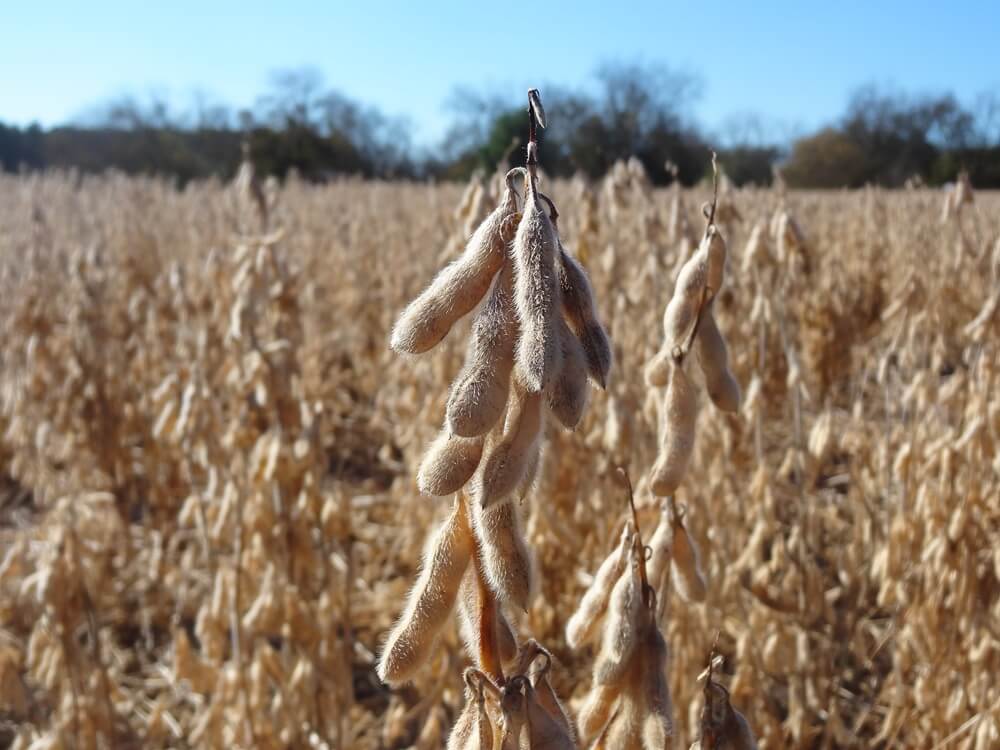
The cover photograph provides soybean-field context and does not depict or diagnose C. phaseoli. Field identification and any species confirmation should rely on appropriate expertise and validated methods rather than a contextual image.
A capability-led route for a catalog gap
ECOPHERO's catalog does not list a product targeting Caliothrips phaseoli or the genus Caliothrips. Catalog thrips products target Frankliniella occidentalis only, so they should not be presented as matched products for this Acre finding. No product, CAS-matched lure, registered use or field-proven solution for C. phaseoli is claimed here.
For teams exploring a species-specific monitoring approach, ECOPHERO can support a semiochemical literature review and a candidate pheromone or attractant synthesis inquiry. Where a candidate proceeds to technical evaluation, ECOPHERO can support analytical verification and lure formulation and dispenser optimization support. ECOPHERO can also provide monitoring-program design and field-validation coordination.
This work needs a clearly defined question. Early detection, seasonal tracking, distribution mapping and comparison of candidate approaches require different sampling layouts and decision criteria. A useful project brief would identify the confirmed target species, crop stage, site and season, monitoring objective, reference observations, proposed replication and the evidence threshold for judging candidate performance.
Any candidate would then need evaluation under relevant soybean-field conditions. Results from another thrips species, crop or geography should be treated as background rather than proof of performance for C. phaseoli in Acre. The Embrapa record supplies a reason to sharpen local observation; a development and validation program must generate the evidence needed for any later operational conclusion.

