
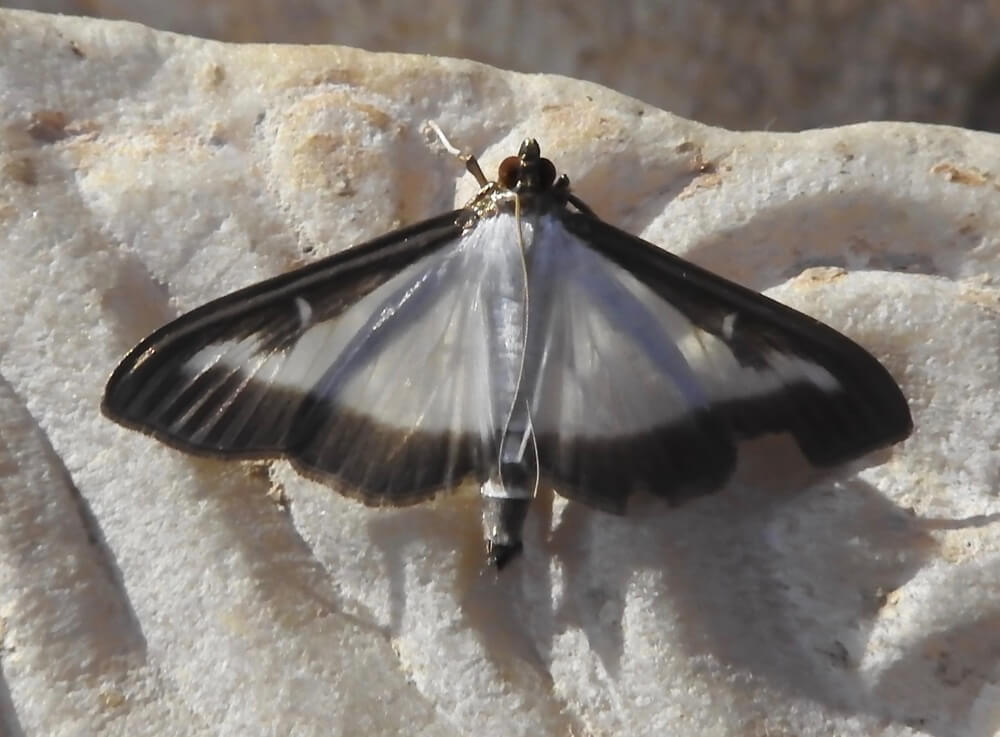
The U.S. Department of Agriculture's Animal and Plant Health Inspection Service (APHIS), working with the Maryland Department of Agriculture and Pennsylvania Department of Agriculture, added five counties to the areas quarantined for box tree moth, Cydalima perspectalis. The action was reported in NAPPO Official Pest Report 1208 on August 25, 2026, and took effect immediately.
The additions cover Allegany, Frederick, Garrett, and Washington Counties in Maryland and Franklin County in Pennsylvania. The federal action mirrors intrastate quarantines established by Maryland on March 6, 2026, and Pennsylvania on May 6, 2026. APHIS said it acted in response to confirmed detections in Washington County, Maryland, on July 10, 2025, and Franklin County, Pennsylvania, on July 28, 2025.
Under IPPC standards, Cydalima perspectalis is a pest that is present, not widely distributed and is under official control in the United States. That wording describes the official status recorded in the report; it should not be broadened into a claim that the pest is established throughout either state or the country.
What the quarantine changes for boxwood movement
The August report connects the quarantine to controls on interstate movement of regulated boxwood articles. Establishments may move boxwood plants interstate from quarantined areas only when operating under a compliance agreement and when each shipment carries a state-issued certificate.
APHIS also prohibits interstate movement of other regulated boxwood material from the quarantined areas, including plant parts, pieces, cuttings, clippings, debris, and any portion of the plant, alive or dead, except for decorative purposes. These conditions distinguish the announcement from a general pest advisory: it records a specific regulatory action and identifies requirements that apply to movement from the named counties.
The report does not support assumptions about individual traps, lures, treatment products, or surveillance schedules used in connection with the detections. It also does not identify a commercial pheromone product for box tree moth. Regulatory requirements and operational guidance remain the responsibility of APHIS and the relevant state authorities.
Pest identity and wider distribution context
Box tree moth is Cydalima perspectalis, listed under EPPO code DPHNPE. The EPPO Global Database datasheet describes it as a defoliator of box trees (Buxus species), native to humid subtropical regions of East Asia and introduced into Europe in the 2000s.
EPPO's distribution record lists the species as present in the United States, including Maryland and Pennsylvania. That database context and the August 25 regulatory report answer different questions. The distribution record provides broader geographic context, while the official pest report documents the addition of the five specified counties to quarantined areas. Neither should be used to infer conditions beyond the locations and scope each source describes.
Precise identification matters for surveillance planning. Common names can be useful in field communication, but the scientific name Cydalima perspectalis and EPPO code DPHNPE create a clearer basis for reviewing literature, defining a target organism, and comparing monitoring evidence across programs.
Monitoring support where no catalog product is listed
ECOPHERO's catalog does not list a product for Cydalima perspectalis or the genus Cydalima. That catalog gap rules out a catalog-backed product recommendation or CAS-matched lure for this event. It also means no registered-use or field-performance claim can be inferred from the catalog.
For teams considering pheromone-based detection and spread surveillance in newly quarantined areas, ECOPHERO can support a semiochemical literature review. That work can organize available species-specific evidence around the intended geography and monitoring question without presuming that evidence for another moth species transfers to C. perspectalis.
ECOPHERO can also support monitoring-program design and field-validation coordination. A useful program brief would define the target species, the counties or sites in scope, the surveillance objective, the observation period, and the evidence required to evaluate a proposed approach. Validation should then be conducted under the intended field conditions before performance conclusions are made.
The NAPPO and APHIS sources establish the quarantine action, while monitoring development remains a separate technical task. Any proposed approach must be evaluated for box tree moth and the program's actual operating context; performance cannot be inferred from the quarantine announcement alone.
For organizations planning box tree moth detection or spread surveillance, the starting point is a clearly framed question grounded in C. perspectalis, the target geography, and the decision the monitoring data must support. Contact ECOPHERO with those details to define an appropriate literature-review and field-validation scope.
Sources and image credit
- NAPPO Official Pest Report 1208 — “Cydalima perspectalis (Box Tree Moth): APHIS Establishes a Quarantine in Maryland and Pennsylvania”
- USDA APHIS — “APHIS Establishes a Box Tree Moth (Cydalima perspectalis) Quarantine in Maryland and Pennsylvania”
- EPPO Global Database — Cydalima perspectalis overview
- EPPO Global Database — Cydalima perspectalis datasheet
- Adult box tree moth image and CC0 license evidence — Rob Mitchell

.jpg)